
Sally Thomas
Equally at home playing with a symphony orchestra or on the stage of a folk club, Sally is a musician with years of experience and a true diversity of musical genres at her fingertips. Her early experience as a classical flute player, blends with her current passion for the English concertina and fascination with traditional music.
She brings the full range of her skills to her partnership with Judy Barker as arranger, harmoniser and occasional composer. As a soloist she employs a thoughtful arrangement style to traditional music, and particularly enjoys exploring a less familiar approach to well-known tunes, whether in terms of tempo or harmony.
“…Sally is an accomplished concertina player. Highlights for me of a consistently enjoyable programme were a thoughtful rendition of Donald Shaw’s Calum’s Road – a tune which is often subjected to session mayhem…” Sheena Wellington, 2026.
As an experienced dance musician Sally also has decades of experience playing with Scottish ceilidh bands, and more recently is enjoying the fun and excitement of bring a Morris musician with Rag Bag Morris in Northumberland.
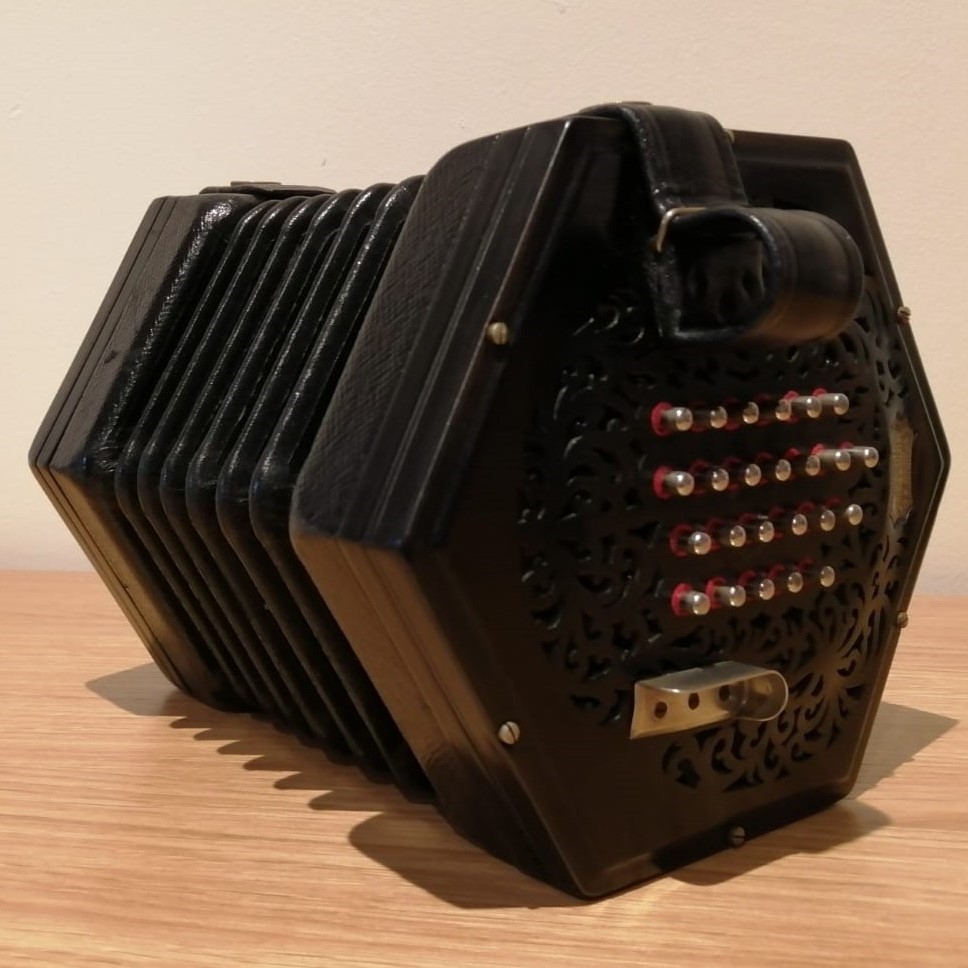
English Concertina (made by Charles Wheatstone)
The English concertina is a member of the concertina ‘family’ of instruments, all of which have free-reeds and are bellows blown. It was invented by Charles Wheatstone who took out his first patent for the instrument in 1829.
(Read more…)
Charles Wheatstone is better known as an eminent physicist and member of the Royal Society. However, he also had a lifelong interest in music, and in musical instruments. The inclusion of ‘English’ in the name of the instrument signifies the type of fingering system used. In the 1820’s and 30’s similar free-reed instruments were being developed in Germany. These German instruments had a different fingering system and were known as ‘Anglo-German’ concertinas (now called Anglo concertinas).
The English concertina is fully chromatic and has the same has the same range as a violin. The buttons are arranged in four rows on each side of the instrument. Each button produces a single note which is same on both the push and pull of the bellows.
The English concertina was originally developed as a classical instrument, although the classical repertoire is seldom played these days. By the 1860’s and 70’s the instrument was used extensively by music hall performers, and by the Salvation Army. The English concertina’s popularity continued into the early 20th Century. But by the 1940’s and 50’s it was beginning to slip into obscurity. Its renaissance came in the 1960’s as part of the English folk revival. It continues to be a popular instrument for folk musicians who value its versatility either as a solo instrument or to accompany song.
There are a small number of English concertina makers today, all of whom make high quality instruments. Many players favour a restored instrument, made either by Wheatstone, or one of the other manufacturers of the 19th and early 20th century. Find out more at the International Concertina Association.
Sally plays a 48-key English treble concertina made by Charles Wheatstone and Company in 1925.

